


The River Is A Woman

On a rooftop overlooking the Mighty Mississippi, with the sun setting along her westward path, I watched young women find their own voices by witnessing a river, imagining her as a woman, and giving her a voice. If the River Were A Woman, Her Voice Media's debut documentary, which premiered last week at The Last Picture House in Davenport, Iowa, explores the Mississippi through women-centered storytelling.
The documentary unfolds in three chapters: Her Ancestry, Her Body, and Her Voice and examines the history of the Mississippi, the health and vitality of her water, and what she might say if she could speak.
The film opens with Alisha Hanes voicing the Mississippi:
I was here before the cities had names, before borders divided the land, before anyone tried to tell me where or how a woman should flow. I am the Mississippi River. For 2,340 miles, my unrelenting currents curved through this country, never asking permission to take up space.
and
I carry people, commerce, possibility and dreams. I am the Mississippi River and if I were a woman, I would cry out to my surrounding shorelines and communities, saying, "I have carried your stories and dreams for centuries. Now, I need you to carry mine."
A river of ideas, emotion, connection, and reflection has raged in me since viewing the film, all of it flowing within the broader currents of our society and world. Watching these young female filmmakers and producers—rivers in and of themselves—seek their shape in a world of levees and dams, pushing forward against the forces that would constrain them, was an emotional experience. They are young women still finding their course, carrying a powerful and often overlooked current, with the capacity to alter the landscape of the world around them.
After the show, I shared a bit of the experience online. I woke up to the comment:
"If the river were a woman, she'd be a real dirty disgusting bish."
The River is a Woman.
We built an economy on her back. We controlled her body to make her more productive to our ends. We constrained her when she became inconvenient or wild. We poured our waste into her. And then, standing safely on shore, we took credit for what she produced and called her dirty.
Her Ancestry
Saukenuk, the great Sauk village, was Black Hawk’s territorial home, and built near the confluence of the Rock and Mississippi Rivers. His understanding of land collided directly with the American concept of private property. Black Hawk put it simply: “My reason teaches me that land cannot be sold.” A few sentences later, he sharpened the point: “Nothing can be sold but such things as can be carried away.”

There is an entire worldview contained in those words. Land could sustain you. You could cultivate it, hunt throughout it, gather from it and make a home upon it. But the earth itself existed beyond its productive value. Humans belonged balanced within a living system; the Earth did not simply belong to humans.
In the film, Her Voice Media fellows interview Sikowis (Christine) Nobis, founder and executive director of Great Plains Action Society. Sikowis explains to the young women, "A river can have rights, just like a human being."
A person with a colonial capitalist mindset might look at an empty field and see it as useless. It's not bringing any value into the world because it's not doing anything that can create wealth. From an Indigenous perspective, that field is doing everything, is doing all the things that it needs to create an environment for whoever is using it. That could be the buffalo and that prairie..., those roots can be up to 30 feet deep and they're holding the soil in place.
Sikowis (Christine) Nobis
European colonization of America had been legally and morally rationalized through ideas like the Doctrine of Discovery, which gave Christian European powers a framework for claiming sovereignty over lands already inhabited by Indigenous peoples. The idea argued that if land was not being used productively or making money, it was free to be taken.
Colonizers faced the dual challenge of taming the people and the landscape they encountered in order to create a foothold for prosperity.
The Rock Island Rapids stretched through a portion of the Mississippi between Hampton and Rock Island, where limestone beneath shallow, swift and changing water made navigation dangerous and unpredictable. The river did not reliably accommodate the boats, schedules and volume of commerce that an expanding economy demanded. The rapids were not a defect in the Mississippi, but their turbulent nature interfered with commerce, so we set about altering the river.
We removed obstructions, blasted rock, dredged channels and eventually built Lock and Dam 15, the largest roller lock and dam in the world, that raised and controlled the water sufficiently to create the nine-foot navigation channel we know today. The great Rock Island Rapids didn't disappear. They remain beneath the surface of the river we engineered above them.
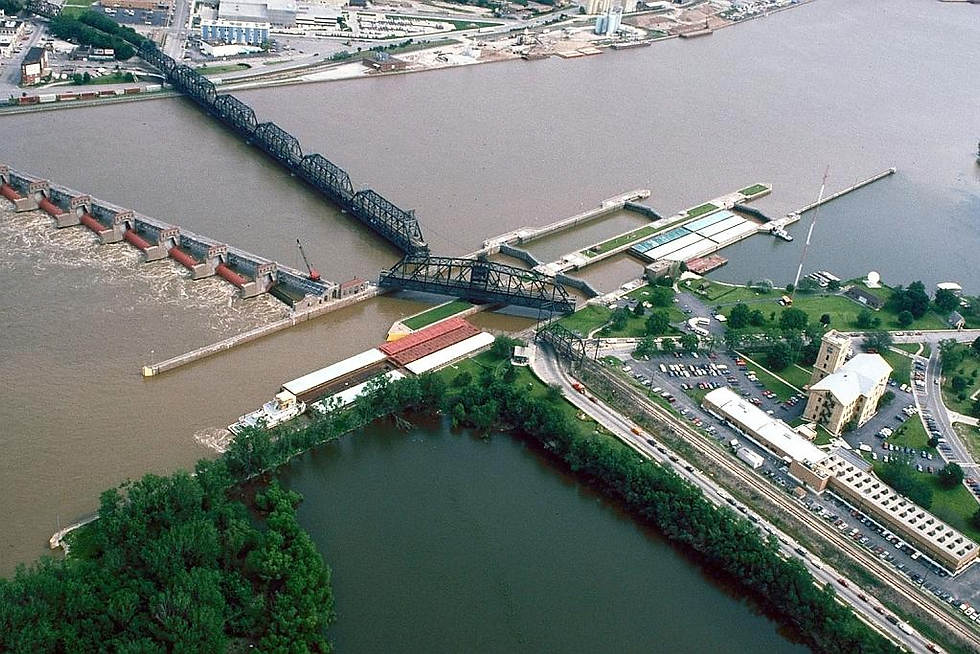
Once controlled, her current became enormously valuable. She could carry the weight of an economy while almost disappearing beneath it. We talk about the barges, the grain, the steel, the manufacturers, the farmers, the jobs and the industries, while the body doing the carrying becomes scenery in the background.
As we did to the river—altering her body, claiming it for our own, turning what she produced into our prosperity—we did to women.
Colonization was not merely the taking of land. It required a philosophy of taking: that what could be conquered could be claimed; what could be claimed could be controlled; and what could be controlled could be made productive for someone else.
When Christopher Columbus set out to colonize America in 1492, violence toward women was not an unintended consequence of colonization but a strategic tool to conquer a people. Indigenous women were routinely raped to threaten, show force, and pressure Indigenous people, as well as being sold to others in systems of sex trafficking. This history of sexual violence carried through the history of slavery. Slaves and their children had no natural rights to safety. In 1976, Nebraska became the first state in America to criminalize marital rape, giving women rights to bodily safety in marriage for the first time in our country. It took until 1993 for all 50 states to outlaw marital rape. And today, we live with the reality that in 19 states, a woman who voluntarily drinks to the edge of unconsciousness is not legally considered incapacitated, so nonconsensual sex with her in that state may not be prosecutable as rape. For the entirety of American history, the absolute rights of women to their bodies have been as foreign to the government of man as the concept of rights of nature.
The ancestral burden of both rivers and women has been to provide and nurture, to lay the foundations for growth while rarely enjoying full rights to their own boundaries—or full recognition of the powerful currents they generate.
Her Body
According to the National Wildlife Federation, nearly 20 million people rely on the river for daily drinking water. The Mississippi River basin is the migratory flyway for 60% of North America’s bird species and home to 260 species of fish. To the surprise of the documentary's littlest participants—elementary school students quizzed on Mississippi River facts—even bull sharks have been known to make their way into her waters.
Her Voice Media fellows sat down with Merredith Peterson, former president of the Rock Island County Historical Society, to explore just how much the Mississippi has given the communities along her banks. She has entertained us, transported us, fed us and built industries for us. Her waters carried the raw materials from which we built our cities. Her mussels supplied an industry that, at its height, produced 80% of the world's pearl buttons. Today, more than 175 million tons of freight move through the Quad Cities on the river each year.
Moline Mayor Sangeetha Rayapati discusses the important role of the bridges that span the Mississippi:
Sometimes people are really isolated in their couple blocks or in the routines that they have every day. And so bridges can help us get beyond that and explore opportunities that we didn't know existed.
Rivers move more than water. They move people, goods, ideas and possibilities. Commerce follows them. Roads and railways grow alongside them. Communities gather around them. Through those connections come exploration, new technologies, economic growth and human advancement.
She gives. And we use her. Like any mother who lets her children use her body for nourishment, her back to climb, her lap to rest, her temperament to shape their personalities, she doesn't mind. But when does use become abuse?
The Mississippi carries an estimated 1.5 million metric tons of nitrogen and phosphorus fertilizer runoff downstream each year, contributing to an oxygen-depleted dead zones in the Gulf of Mexico that has, at times, grow to roughly the size of New Jersey. Around the world, 11 million metric tons of plastic enter the ocean each year. And like an enormous drainage system, the Mississippi collects water, and the pollution carried with it, from a watershed spanning roughly 40% of the continental United States and 31 states before emptying into the Gulf. After everything we ask her body to give us, pollution is the primary thing we give her in return.
What happens to a body that gives without receiving? Produces without replenishment? Carries without being supported?
We depend upon bodies—human and natural—to carry enormous burdens for us, often without noticing the labor until something stops flowing. We celebrate what they produce while paying far less attention to what their continued production costs them.
Women now make up roughly half of the American workforce, yet still make less money than men. Women spend a disproportionate amount of their time carrying out three quarters of the world’s unpaid work, estimated at 11 billion hours a day. Women's work is like a current, often unseen and overlooked but moving so much of the lives dependent on it for their own prosperity.
A body tells us something about the culture in which it lives. In the United States, roughly one in four women has experienced completed or attempted rape. Nearly half of women will experience sexual violence, physical violence or stalking in their lifetime. Among comparable high-income nations, the United States remains the most dangerous place to give birth, measured by maternal mortality. For Black women, the maternal mortality rate has recently been more than three times that of white women.
Women and rivers are not the same. But perhaps our relationships with their bodies reveal something similar about us. We depend upon them. We draw life from them. We build families, communities and economies around what they provide. Yet dependence does not necessarily produce reverence. Too often, we measure a body by what it can give, tolerate or carry before we ask what it needs to remain whole.
Kathy Wine of River Action explains that caring for the Mississippi begins by allowing people to develop a relationship with her:
“If you can't be on the river, see the river, do something on the river, you won't be in love with it. But if you're in love with it, then you become an advocate for it in all different ways.”
Love changes the relationship.
As we learn in the film, organizations like River Action and Living Lands & Waters operate from a fundamentally different posture toward the river. Living Lands & Waters goes directly into the places where our waste accumulates, pulling tires, plastic, appliances and thousands of pounds of garbage from her shorelines. River Action works to connect people to the river through conservation, recreation, sustainable infrastructure and public access.
If we love a body enough, will we listen to her?
Her Voice
In Chapter Three of If the River Were a Woman, young women are asked a simple question: If the river had a voice, what would she say?
“Please take care of the things you love.”
“Why can't these people treat me right?”
Why can't these people treat me right? It is the language of relationship. It imagines the river not as scenery or infrastructure or a resource, but as something we are in relationship with. Something capable of being cared for, neglected, protected or harmed.
The river cannot actually ask us to stop. She cannot refuse a pipeline, reject the waste we pour into her, object to a dam or appear before a legislature to defend the boundaries of her own body. Whatever limits exist on our power over her must be imposed by us.
And that presents a more difficult moral question than listening to something capable of demanding its rights.
How do we treat something that cannot tell us no?
Consent is permission, within a relationship, to act. At its core, consent places a limit on power. It says: Just because I can do something does not mean I am entitled to do it.
When two parties possess relatively equal power, those limits can be negotiated. But the greater the imbalance of power, the greater the responsibility falls upon the powerful to restrain themselves.
The question is larger than whether the river should have a voice. Or whether young women should have a voice.
What does power owe to that which it has the ability to overpower?
We are beginning to confront a strange inversion of that question as we build increasingly capable artificial intelligence. AI researchers use the term corrigibility to describe a quality we desperately hope advanced systems will retain: a willingness to accept correction, redirection or shutdown by humans even when doing so interferes with the objective the system is pursuing.
Think about what we are asking.
We want something more powerful than ourselves to recognize our boundaries. We want it to stop when we say no. We want our vulnerability to create an obligation in the powerful rather than an opportunity.
It is difficult not to turn that question back on ourselves. When nature resists us, are we corrigible? When a river floods the boundaries we constructed for her, do we reconsider where we built, or simply build a higher levee? When an ecosystem cannot sustain what we are extracting from it, do we change our objective? When another human being says this is my body, my boundary, my life, do we understand that our ability to exert power does not give us the natural right to do so?
Before asking whether artificial intelligence will respect the limits human beings place upon its power, perhaps we should examine how faithfully we have respected the limits placed upon ours.
Who gets a voice? And who is in the room to hear that voice?
There is evidence that the treatment of women and the treatment of the natural world are not entirely separate cultural questions.
Anthropologist Peggy Reeves Sanday's study of 95 societies found rape-prone cultures associated with male dominance, interpersonal violence, separation between the sexes and struggles for control amid environmental insecurity. In societies she characterized as rape-free (meaning rape was a rare event), women's contributions were more highly respected and men and women occupied more balanced spheres of power. Sanday made another observation particularly relevant here: where people lived more harmoniously with their environment, rape was usually absent.
Modern research approaches the question differently but finds an intriguing pattern. Greater representation of women in national parliaments has been linked to stronger climate policies and lower carbon emissions. Research exploring changes in board-diversity laws across countries found that increases in female corporate directors following those reforms were associated with reductions in corporate carbon emissions.
And a 2026 study in Brazil offers particularly compelling evidence. Researchers compared extremely close elections between male and female mayoral candidates. Municipalities narrowly electing women subsequently experienced lower greenhouse-gas emissions, particularly in the Amazon. The difference was driven largely by lower deforestation, while female mayors also devoted more attention and resources to environmental protection and increased enforcement of environmental regulations.
Who is in the room changes what the room values.
In the United States, some mechanisms explicitly intended to increase or preserve women's representation have recently been eliminated or weakened. Nasdaq repealed its board-diversity requirements after a federal court struck them down. Women's representation on Russell 3000 boards has since stalled and begun to decline, falling from a peak of 30.3 percent in early 2025 to 29.6 percent in the second quarter of 2026. Only about one in five new board appointments that quarter went to women.
The White House Gender Policy Council has been dissolved. At the Pentagon, the longstanding advisory structure devoted specifically to women in military service was dismantled as the Defense Department moved away from sex- and diversity-based organizational goals.
Environmental policy is undergoing its own retreat. A 2025 executive order directed federal agencies to terminate environmental-justice offices, positions and programs alongside DEI initiatives. In 2026, the EPA rescinded the greenhouse-gas Endangerment Finding that had underpinned federal regulation of vehicle greenhouse-gas emissions, along with the associated emissions standards. The administration describes these changes as restoring merit, reducing regulatory burdens and returning federal agencies to the limits of their legal authority.
Her Voice Media's fellows are, in a sense, a test of these ideas: put young women behind the camera, and the river becomes not scenery or infrastructure, but an entity with a story.

The simultaneous demotion of women and nature reflects a world tilting on an axis: toward power over—toward domination rather than relationship, extraction rather than reciprocity. It is a world falling out of balance.
And the tilt is getting worse.
The River Turns Here
A single drop of water is soft. It conforms to the hand that holds it. It moves around an obstacle in its path. Its tiny body can refract the light of the world and offers hope for renewal. Alone, it can be contained, redirected, absorbed, evaporated.
As women, we know what it is to feel powerful inside ourselves and still be overpowered. To speak and not be heard. To give life and embody complexity and have simplicity mirrored back. To bend around something stronger because sometimes that is what survival requires.
Water enjoys the property of cohesion. Water is drawn to water. Drops gather into streams, streams into rivers, rivers into oceans. Together, water becomes one of the most powerful forces shaping the earth. It cuts through rock and moves mountains piece by piece. It extinguishes fire and carries life. Over time, it reshapes the landscape in its path.
Water does not have to become harder to become powerful. It only has to become collective.
Maybe women are like that, too.
Our individual resources may be smaller. Our organizations may have less money. Our voices may not always carry as far as those backed by powerful patriarchal institutions. But we have one another. We can pool what we have—our resources, our stories, our knowledge, our creativity, our voices.
Her Voice Media is itself an example. It began in 2012 as Love Girls Magazine, created by a teenage Jasmine Babers-Gunn as a place for girls to tell their own stories. What started as a magazine “for girls, by girls” gathered more voices around it and grew into Her Voice Media, a multimedia organization centered on the stories and leadership of women and girls.
And now, in If the River Were a Woman, those young women have turned their cameras toward something else whose story has too often been told through the lens of its usefulness to and definition by others.
The river.
There is something beautiful in that progression. Women telling their own stories, then using the voice they built together to tell the story of the natural world, the most voiceless, around them. One voice carrying another. One story carrying another. Each adding something to the current.
The filmmakers' choices model a collective female power rooted not in domination but in restoring balance — between women and men, between human beings and the natural world, between what we take and what we return, between power and restraint.
Women restore balance, not through strategies of violence, but through speaking and gathering. By listening. By telling our stories and helping one another tell theirs. By pooling what we have, even when individually we have less. By making sure women's voices are not isolated drops, but part of a growing current.
One drop can be moved. One story ignored. One woman disregarded.
Collectively, water changes the world. I have hope women can do the same.


I am both moved and encouraged by this thoughtful article.