


$30 Million Question: Should Rock Island Extend the "Casino TIF" Another 12 Years?

Whether tax growth that has been captured for more than two decades finally returns to the schools, local governments, and public services that support daily life—or remains reserved for redevelopment purposes within limited geographic areas.
On July 13, the Rock Island City Council takes a first step toward asking Springfield for a 12-year extension of the Parkway/I-280 TIF District — the “Casino TIF.” Before City Council approves the extension, our community deserves a clear-eyed look at what's being decided: whether the tax-base growth we've set aside for more than two decades finally rejoins the ordinary budgets that run our city and schools, or stays reserved for economic development in limited geographic areas.
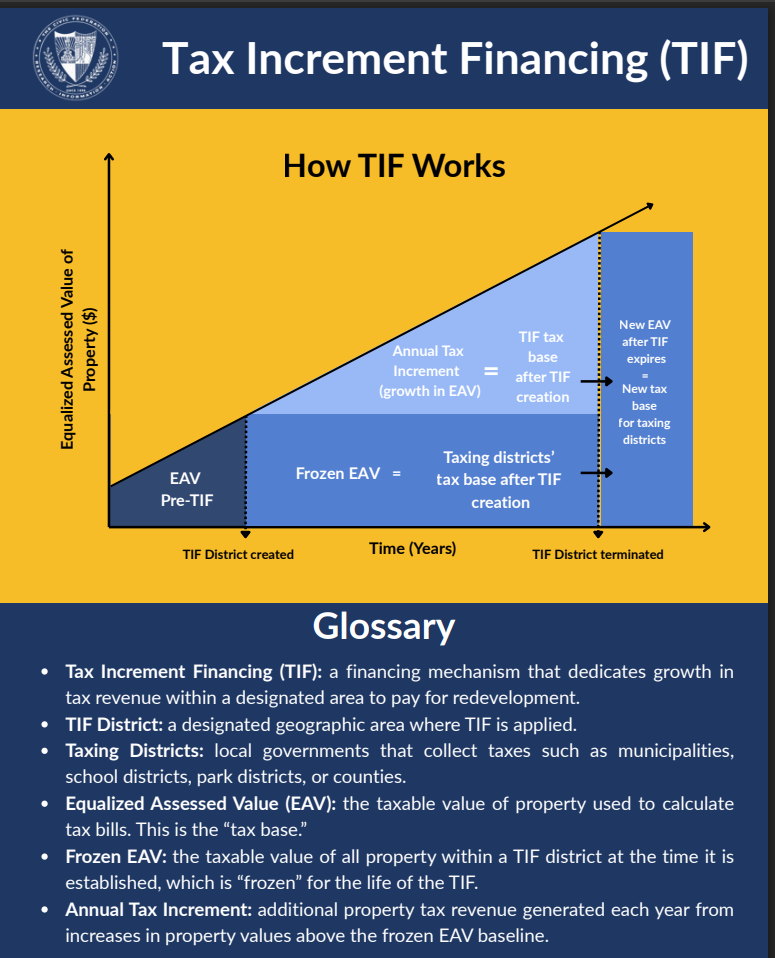
Tax-increment finance, or TIF districts, are important economic development tools that capture increases in property tax over time and return those captured funds to a designated geographic area to incentivize redevelopment. The central justification for TIF is that projects, particularly private investment, would not occur “but-for” public financing.
Casino TIF
The Casino TIF was created in 2004 and is set to expire in November 2027 after a standard 23-year period.
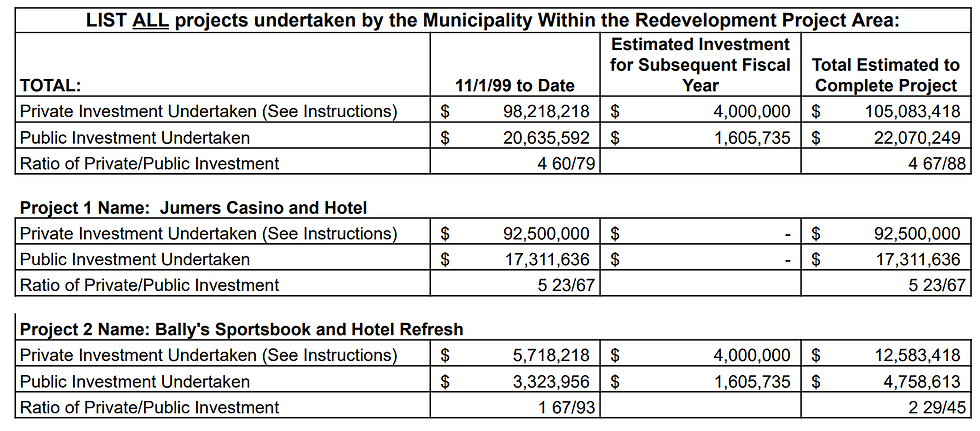
It helped bring in roughly $98 million in private investment, including the $92.5 million casino now operating as Bally's (according to most recent public documents available for 2024). In April 2026, the Nature's Treatment Marijuana Dispensary and gas station project broke ground on their new site which is the final planned redevelopment utilizing TIF funds from the Casino TIF.

Monday night's proposal would keep the casino core inside the district for another twelve years, while also creating a new South Rock Island Port District TIF for future projects, thus seeding the new TIF district with funds that would otherwise return to the taxing bodies.
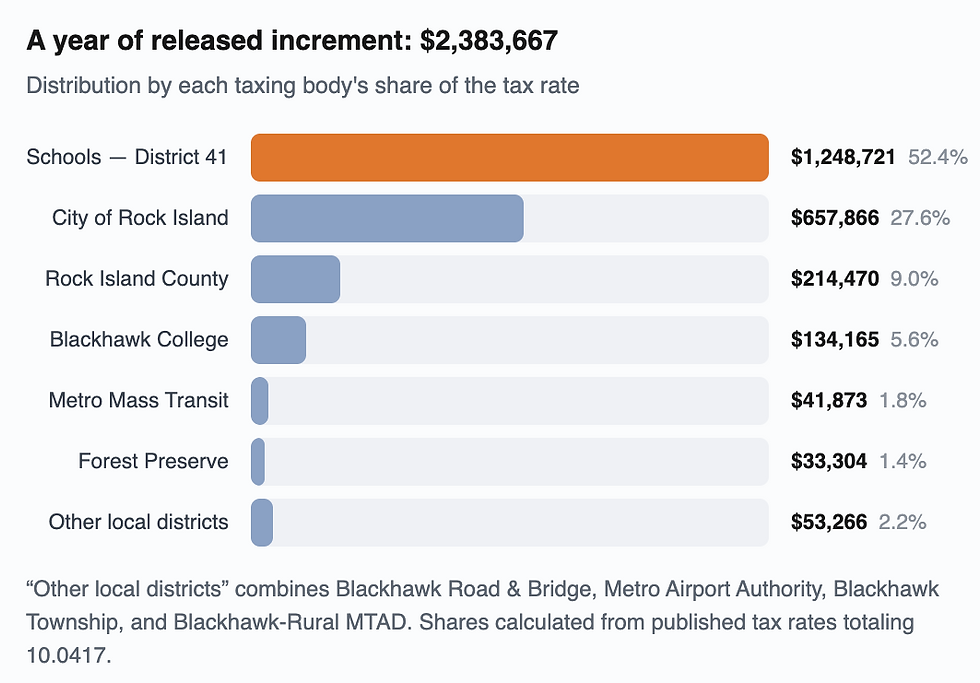
$2.38 million a year that stays captured inside the district — instead of returning to the taxpayers, schools, and services that share every other property-tax dollar in Rock Island.
Where this money would go if the TIF is not extended
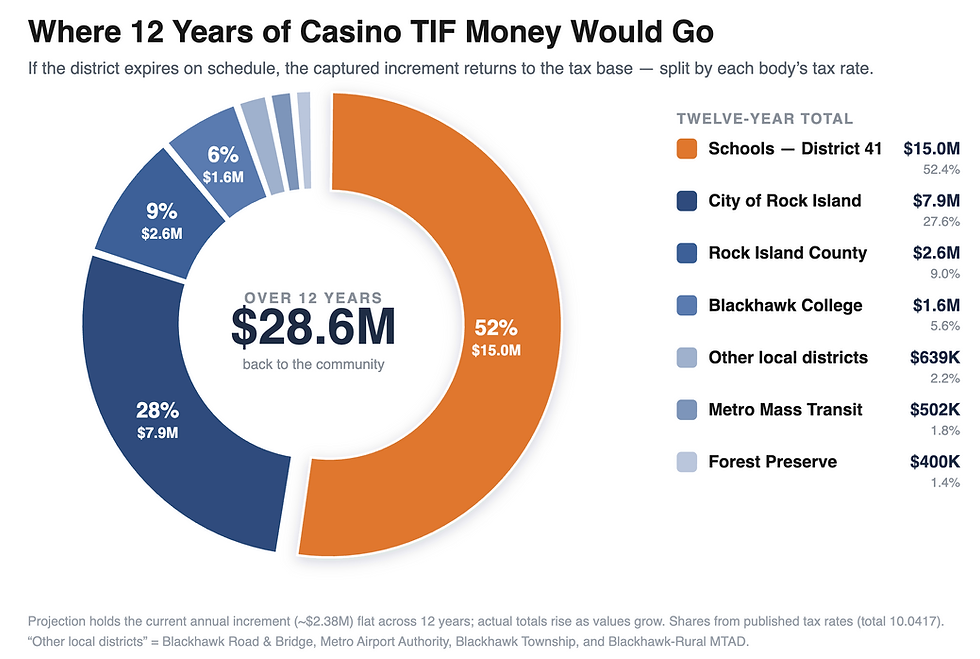
When the district expires, that increment doesn't vanish or fall to City Hall's discretion — it's shared out among every taxing body, split by the same tax rates that appear on your own property tax bill. Here is exactly where a single year would land:
Pressures Expansive TIFs Create
Successful TIF districts create a paradox. They can spur investment, increase property values, and attract development while simultaneously capturing the very tax growth that would otherwise help support the city around them.
In Rock Island, this pattern looks like multiple TIF districts with healthy balances, millions of dollars, while the City dips into its reserve to balance the budget.
New development brings new demands. More residents, businesses, and visitors mean additional pressure on roads, public safety, schools, parks, libraries, and infrastructure. Yet when the resulting property-tax growth remains inside a TIF district, the revenues available to support those services do not necessarily grow alongside the need for them.
Heavy reliance on TIF can also create geographic tensions. Areas inside redevelopment districts may receive infrastructure improvements, site preparation, environmental cleanup, and other investments funded through captured tax growth. Neighborhoods outside those districts must typically compete for improvements through the ordinary budget process.
Over time, residents may begin to wonder whether public investment is being driven by community need or by where TIF dollars happen to be available.
Another concern identified in the literature is what happens when TIF becomes the expected way of doing business. Developers begin to assume incentives will be available. Cities become accustomed to using them. The question shifts from "Does this project truly require assistance?" to "What incentive package should be offered?" As that occurs, the "but for" test—the principle that a project would not proceed but for public assistance—can become increasingly difficult to apply in a meaningful way.
Critics sometimes describe this dynamic as an off-budget system. The concern is not secrecy; TIF expenditures are public. Rather, the concern is that opportunity costs become easier to overlook. A redevelopment expenditure is viewed as money available for a project, rather than money that might otherwise have flowed to schools, local governments, transit agencies, or other taxing bodies if the district had expired.
None of these concerns prove that a TIF extension is wrong. They simply underscore why successful TIF districts deserve the greatest scrutiny. When a district has generated millions of dollars in increment, accumulated substantial reserves, and fulfilled its original purpose, the burden should shift from proving why it should expire to explaining why it should continue.
The Strongest TIF Districts
As stated, TIF is a powerful economic toold to have in the toolbox and is effective when the following conditions are met:
Narrow boundaries
Specific projects identified in advance
a rigorous, independently reviewed "but for" analysis
Limited duration
Conservative revenue projections
No automatic extensions
Measurable jobs, investbment and tax-base targets
Regular surplus declarations
Protections for schools and other taxing bodies
Public reporting of performance
How this applies to the Casino TIF
The Parkway/I-280, or "Casino,"TIF is not a struggling district asking for more time to finish an unfinished rescue. By FY2024 it generated about $2.47 million in annual increment, had collected more than $34 million over its life, ended the year with a $2.62 million fund balance, and had seen its equalized assessed value rise from roughly $161,000 to $24.3 million.
It was successful, in part, because it focused on a relatively narrow geography and a defined redevelopment objective. The new TIF districts are very large and rely on a strategy of moving money between TIFS, exactly the type of behavior researchers warn can create harmful consequences to the underlying community.
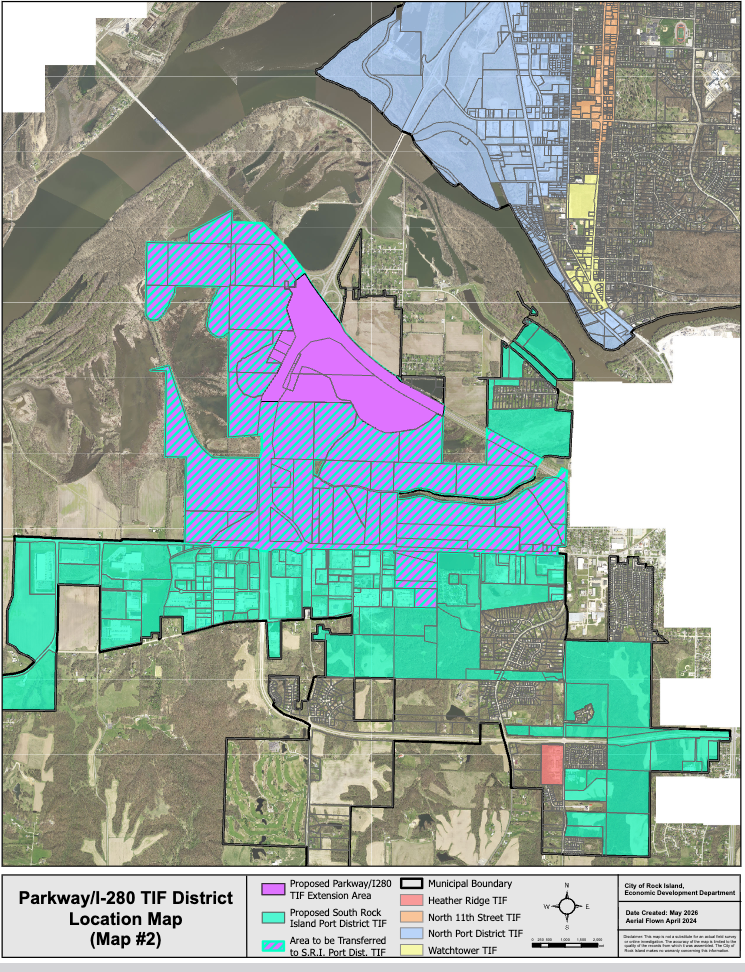
Maps presented Monday night show the massive size of these new TIF districts compared to their older neighboring TIF districts. The trend of late is for the City to take money or propose taking money from older TIF districts that had to operate in very limited scope and geographic areas, most of these districts representing the truly blighted and poorest communities, and transfer their existing funds to TIF districts with more potential for private investment.
New TIF districts include Proposed Parkway/I280 Extension, Proposed South Rock Island Port District TIF, and the North Port District TIF. Together, these districts dwarf all the others. Given that a city runs additional risk by expanding the TIF footprint, this massive expansion of TIFs may make it less feasible to have a TIF district on a future site that may actually meet the criteria for TIF, which are blight and decay, financing gaps, and civic projects that improve the neighborhood/community.
When a Tool Becomes a System
The research literature is fairly consistent on one point: TIF is most defensible as a limited, targeted intervention aimed at overcoming a specific redevelopment obstacle. Concerns emerge when districts become larger, longer-lasting, and interconnected in ways that keep tax growth from returning to the ordinary tax base.
At that point, policymakers must ask whether TIF is still creating new economic activity—or merely capturing growth that would have occurred anyway while delaying revenues that would otherwise support schools and local governments (Dye & Merriman, 2000; Merriman, 2018; Lincoln Institute of Land Policy, 2022).
Rock Island is very actively restructuring and expanding TIF districts at this time and it is worthwhile to consider the pros and cons of relying heavily on this incentive structure. The danger of relying too heavily on TIF is not simply that money is “taken away.” It is structural: the city's visible development economy grows inside restricted funds while the ordinary government responsible for sustaining the community stays strained underneath it.
This does not mean the extension must automatically be rejected. It means the city should have to prove its case before locking up another twelve years of growth:
The specific projects genuinely require TIF to proceed.
Their public benefits exceed roughly $28 million or more in continued tax capture.
The city, schools, county, college, and service districts can afford another 12 years without that growth.
The plan will not simply create a permanent chain in which one TIF feeds the next.
A smaller district, a shorter extension, a partial surplus distribution, or project-specific financing could not achieve the same goals at lower public cost.
Without those findings, extending a successful TIF while the city draws on reserves to balance the budget risks strengthening the development apparatus while weakening the city it is meant to serve. And remember: an Illinois extension requires unanimous approval from every overlapping taxing body — District 41 included — plus special legislation from Springfield. Our school board holds a veto. So does the county. So should the community.
Sources:
Dye, Richard F., & Merriman, David F. (2000). The Effects of Tax Increment Financing on Economic Development. Journal of Urban Economics, 47(2), 306–328.
Merriman, David F. (2018). Improving Tax Increment Financing (TIF) for Economic Development. Lincoln Institute of Land Policy, Policy Focus Report.
Lincoln Institute of Land Policy. (2022). Tax Increment Financing: A Tool for Local Economic Development. Cambridge, MA.
City of Rock Island. (2024). Parkway/I-280 (Jumers) Tax Increment Financing District Annual Report, FY2024.
City of Rock Island Community Development Department. (2026). Report Regarding Agreements for the Creation of the South Port TIF and Extension of the Parkway/I-280 TIF.
Tax Increment Financing Wikipedia Page: https://en.wikipedia.org/wiki/Tax_increment_financing


Comments