


Three Winters Downtown

Updated: May 18
What the Crime Data Shows About Shelter, Services, and Public Safety in Rock Island
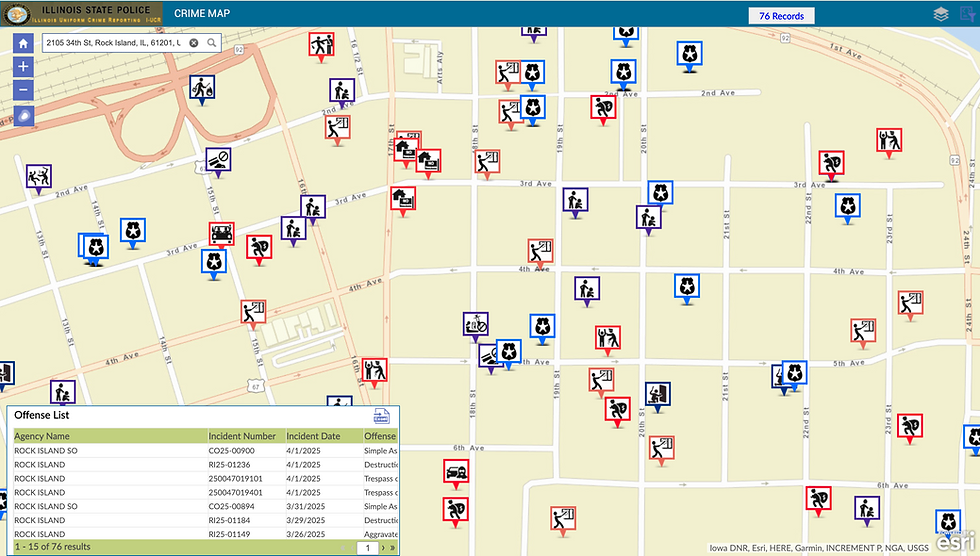
The Illinois State Police maintains a public crime map drawn from data that every law enforcement agency in the state is required to submit each month. The map allows users to search a geographic area and pull individual offense records: agency, incident number, date, offense type, and address.
This analysis pulled three years of records — January through March of 2024, 2025, and 2026 — for a roughly ten-block stretch of downtown Rock Island bounded by 13th Street, 24th Street, 1st Avenue, and 6th Avenue. The three winters represent three different configurations of homelessness services in the neighborhood:
2024: No emergency overflow shelter, no day drop-in center, Christian Care permanent shelters
2025: Project Now operated an overflow shelter at 418 19th Street from January through April, serving an average of 28 guests per night, no day drop-in center, Christian Care permanent shelters
2026: No overflow shelter operated in Rock Island. Third Place QC, a daytime drop-in opened in October 2025 and serves 80-100 guests a day, Christian Care permanent shelters, Moline emergency overflow shelter opens and provides bus passes to Third Place QC daily.
A previous Rock Island Line article examined citywide calls-for-service data across the same three winters. That data was the only data publicly available at the time. It was useful for understanding overall trends but too broad to answer questions about specific neighborhoods. This piece uses founded offense data at the address level for the area where the overflow shelter and day drop-in center are located.
Section 1: The Data
The state crime map returned 49 offenses in this neighborhood for January–March 2024, 72 offenses for the same period in 2025, and 38 offenses for 2026.

These are founded offenses — incidents that police investigated and determined actually occurred. They do not include calls for service that did not produce a report.
The bars above are divided into three categories based on where the offenses occurred.
The bottom segment of each bar — labeled Neighborhood — represents reported offenses at street-level addresses across the area. This is the activity most relevant to a conversation about neighborhood conditions.
The middle segment — labeled Public housing and transit hub — represents reported offenses at two specific institutional addresses: Spencer Towers, a 100-plus-unit low-income housing building at 111 20th Street, and the MetroLINK transit hub at 1975 2nd Avenue. These are large-scale service locations that generate reports as a function of their size and use, in ways that are not specific to street conditions in the surrounding blocks.
The top segment — labeled Criminal justice — represents reported offenses at the Rock Island County Jail at 1317 3rd Avenue and the Rock Island Police Department at 1212 5th Avenue. Most jail incidents are simple assaults that occur inside the facility between inmates or involving staff. Reports at the police department address are typically incidents that walked in the door.
Removing the criminal justice addresses, the three-year totals become 37, 56, and 28.
Removing the public housing and transit hub addresses as well, the three-year totals become 28, 44, and 21.

The shape of the three-year story does not change at any level of refinement. Reported offenses rose substantially in 2025, when the overflow shelter operated, and fell to their lowest level in 2026, when no overflow shelter operated but Third Place QC was open during the day.
Service-provider addresses for the unhoused population are not excluded from any of these counts. Christian Care, Project Now's main office, the 418 19th Street overflow shelter, and Third Place QC all remain in the neighborhood category, because the question this analysis asks is whether services for the unhoused population correspond to changes in nearby reported crime. Excluding them would defeat the purpose.
Of note: Across the three years combined, the Christian Care shelter at 2209 3rd Avenue accounts for five reported offenses, all in 2025. The Project Now overflow shelter at 418 19th Street accounts for four reported offenses, all in 2025. Third Place QC at 2000 3rd Avenue accounts for one reported offense across the three years. The Project Now main office at 1830 2nd Avenue accounts for one. These four service-provider addresses together account for eleven of the 159 offenses in the three-year dataset, or roughly 7%. The majority of incidents, ~24%, occur at the police station and jail by significant location.
The single largest year-over-year shift at any one address was at the MetroLINK transit hub.

Reported offenses at 1975 2nd Avenue went from six in 2024, to nine in 2025, to two in 2026. The transit hub is three blocks from the Third Place QC daytime drop-in center, which opened in October 2025.
Section 2: How Did You Get This Data?
This data was not provided by the Rock Island Police Department. It was assembled from the Illinois State Police public crime map. The full report is available here:
A Freedom of Information Act request to the City of Rock Island in May 2026 sought records describing what data fields the police department's CAD/RMS system captures, what reports the system can generate, and what prior data exports the department has produced for outside parties. The City's responses confirmed the department uses CentralSquare Pro as its system of record. The remaining portions of the request were denied. The City takes the position that describing how its system works, or what its standard reports look like, would require creating new records that FOIA does not compel.
The police department was unable to create a report for this article as the creation would be "unduly burdensome" and therefore is exempt data under FOIA guidelines.
The City also confirmed that the police department has produced a custom data extract for a city official, broken down by neighborhood and year, that summarized police activity in this similar downtown area for service calls across the three winters analyzed here. That extract is a summary table only. The underlying records that would allow a resident or independent journalist to verify or build on it are not available through any public channel.

Decisions about emergency shelter operations, public space, and policing in Rock Island affect residents, business owners, service providers, and the unhoused population. The data needed to inform those decisions exists, is already being extracted on request for some parties, and could be published in a form residents could use.
Good policy relies on accessible data that can be analyzed by independent third parties.
Section 3: Analysis
What emerges from this data is not a simple political talking point. It is a more complicated reality.
The winter of 2025 was difficult for many downtown business owners and nearby residents. The data reflects a real increase in founded offenses during the months when the emergency overflow shelter operated in Rock Island. That increase occurred at a time when many businesses were already carrying the financial and emotional strain of years of disruption — from the lingering effects of COVID-19 to prolonged downtown road construction and infrastructure work. For some, the added instability felt like one more burden placed on a downtown already struggling to recover. That frustration deserves acknowledgment, not dismissal.
At the same time, the 2025 overflow shelter was not created under ideal conditions. It was assembled in a matter of weeks in response to an immediate humanitarian emergency: people sleeping outside in dangerous winter conditions. The shelter represented an improvised effort by Project Now and the City of Rock Island to prevent loss of life with limited time, funding, and infrastructure. It was never a fully developed system. It was an emergency response.
The 2026 data suggests something important may have changed when daytime services were added to the equation.
Third Place QC, which opened in October 2025, serves roughly 80 to 100 unhoused individuals daily — several times the nightly capacity of the prior emergency overflow shelter in Rock Island. And during the first winter in which a daytime drop-in center operated alongside nighttime sheltering in Moline, reported offenses in this downtown study area fell to their lowest levels of the three-year period.
No single dataset can prove causation. But if these numbers suggest anything, they suggest that providing people with structured places to exist during both the day and night may matter. A system that only addresses where people sleep, while leaving people with nowhere to go for the remaining 16 waking hours of the day, may be inherently unstable — both for unhoused individuals and for the surrounding community.
Being poor is not a crime. Being homeless is not a crime.
And communities cannot arrest, exclude, or ordinance their way out of homelessness. The long-term solution is not simply shelter beds. It is housing, treatment, economic stability, community support, and systems designed to prevent people from falling into homelessness in the first place.
But communities also cannot ignore legitimate concerns about public safety, disorder, and neighborhood impact. Residents and business owners deserve safe, functional public spaces. The answer cannot be pretending problems do not exist.
The answer is planning better. And good data, not anecdotal storytelling, driving policy decisions.
If the standard for closing a facility is that crimes occur there, then cities would close police departments and jails - the single driver of crime numbers in the downtown area. If the standard is reducing calls for service at all costs, hospitals, senior care facilities, schools, and emergency rooms would all become liabilities rather than public necessities. Places that serve high-needs populations inevitably generate more interaction with public systems because human need itself generates calls, crises, conflict, and intervention.
Special populations require special planning. Rock Island should be focused on inclusionary and effective planning rather than exclusionary policies that treat the homeless as second-class citizens, with more restrictive shelter delivery distance requirements than registered sex offenders experience.
Homelessness is a real public health and social policy dilemma that every city must reckon with. Planning has to involve service providers, city government, police, business owners, residents, and homeless individuals themselves. It requires transparency, accessible data, honest evaluation, and a willingness to refine systems when they are not working. Data should not be used as a weapon to shut down dialogue or stigmatize vulnerable people. It should be used to improve service delivery, strengthen public safety, and build systems that preserve both human dignity and community order.
That balance is difficult. But this data suggests it is possible.
Data sources: Illinois State Police I-UCR / NIBRS public crime map; City of Rock Island FOIA response, May 2026. Methodology and underlying records available on request.


Comments