


Should City Employees Live in the City They Serve?

Residency, Research, and Economic Health
Residency requirements for municipal employees — including police and fire — are hotly debated. Since its founding, Rock Island has had a rainbow of residency requirements that have mandated certain professionals live in the city limits, live in Rock Island County, and/or live within various radii of the city.
Currently, the ordinance outlining residency requirements reads:
(a) All employees of the city hired after January 1, 2020, shall live with the States of Illinois or Iowa and maintain a sixty (60) minute response time to the intersection of 17th Street and 31st Avenue in Rock Island, Illinois unless their collective bargaining agreement grants an exception to this section.
(b) All new employees of the city hired after January 1, 2020, shall be allowed up to six (6) months from the expiration of their probationary period to relocate into the defined area.
(c) Employees of the city hired after June 10, 1991, shall be allowed to live within the States of Illinois or Iowa and maintain a sixty (60) minute response time to the intersection of 17th Street and 31st Avenue in Rock Island, Illinois, unless their collective bargaining agreement grants an exception to this section.
(d) This section shall not apply to employees where both husband and spouse are employees of the city of Rock Island and one of said employees was hired prior to June 10, 1991, and the other spouse subsequent to said date.
The most recent change was adopted in 2019, the history and language of which can be reviewed here:
Should public servants share in the daily life of the community they serve?
This question can feel moral or symbolic. Simply posting the figures for community review ilicits a range of strong reactions. But the topic has practical implications: What happens to a city’s economic health when public payroll and pensions live inside the city — or outside of it?
Recently reviewed payroll data gives us scale.
What the Numbers Show
The city currently employs:
360 full-time employees
Average salary (with longevity): ~$74,600
Median salary: ~$73,800
That represents approximately:
$26–27 million in annual full-time payroll
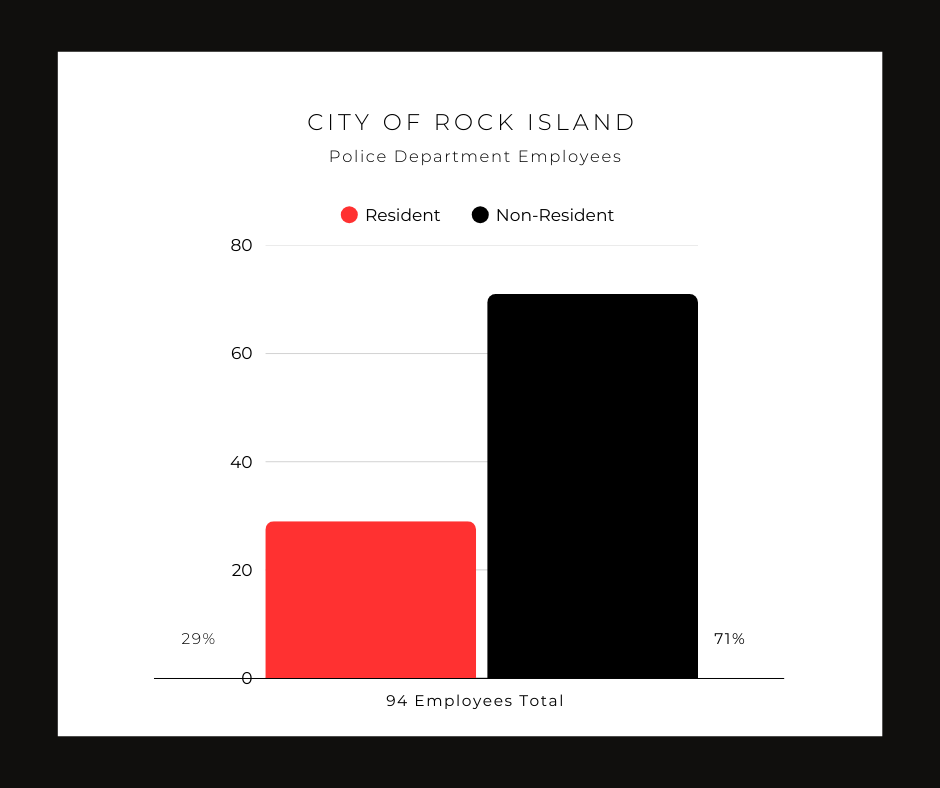
Currently, roughly 57% of overall employees live outside of Rock Island. In some departments, like police and fire, that number is ~70% of employees living outside the city. Based on the overall average of 57%, that means:
$15 million per year flows to households outside city limits
In addition:
278 part-time employees
42 seasonal employees
Average hourly rate: ~$15 per hour
Full-time equivalent: ~$31,000 annually
Of course, part-time and seasonal staff do not work 2,080 hours annually, but these roles represent important entry points into the municipal workforce — especially for younger residents.
The economic implications are straightforward:
When a $74,000 household lives inside the city:
Property taxes stay local.
Housing investment stabilizes neighborhoods.
Grocery and service spending circulates locally.
Pension income may remain local after retirement.
School enrollment stabilizes.
When that same household lives outside the city:
The salary still originates locally.
But much of the economic multiplier shifts outward.
In cities with moderate labor force participation and measurable poverty, public payroll is one of the most stable economic anchors available.
During his State of the City Address, Mayor Ashley Harris highlighted the importance of commitment to community. Mayor Harris highlighted that his first decade of life in Rock Island, from 1980-1990, Rock Island lost over 7,000 residents. While I am still trying to pinpoint when Rock Island dropped its requirements that city staff live in Rock Island, I believe it was in the early 1980s. Could this exodus in population be tied to a change in residency requirements? Or is the exodus the reason residency requirements became more challenging to uphold?
What Research Says — and Doesn’t Say
One important reality: research on police residency requirements is limited and mixed.
A 2020 USA Today analysis examining residency across major cities found no strong empirical evidence that simply requiring police officers to live in the cities they patrol reduces crime or improves public trust. The article emphasized that while residency is politically appealing, measurable outcomes are difficult to demonstrate.
Similarly, a 2021 (Villa) quantitative study comparing cities with and without police residency requirements found no consistent statistical relationship between residency and reductions in violent crime or citizen complaints.
Residency has not been shown to be meaningfully change the quality of a police force or satisfaction of residents.
Looking to Education for Better Evidence
Because research on police and general employee residency is limited, it helps to look at adjacent public sectors — particularly education.
Direct research on whether teachers must live in the district they teach in is also limited. However, there is a much stronger body of research on teacher residency programs — structured models that embed teachers in a district through mentorship, long-term commitment, and community integration (Guha et. al, 2016)
What seems to matter more than residency in teaching is that teachers spend a year understanding and integrating with the community where they teach.
The findings are instructive:
Residency-trained teachers show higher retention rates.
Structured community immersion improves long-term effectiveness.
Local workforce pipelines create stability.
It’s not simply the address that matters. It’s the integration, support, and pipeline-building.
In other words, place-based commitment works best when it is structured and incentivized — not merely mandated.
The Pros and Cons — Clearly
Arguments for Residency
Keeps public payroll circulating locally.
Strengthens property tax base.
Stabilizes neighborhoods.
Encourages civic embeddedness.
Supports long-term pension circulation.
Arguments Against Strict Mandates
Shrinks hiring pool for specialized roles.
May create recruitment friction for police and fire.
Does not have strong empirical backing for improved policing outcomes.
Housing supply may not match workforce needs.
The evidence suggests caution against rigid mandates. But it does not suggest residency is irrelevant.
A Smarter Strategy: Incentivize and Build Pipelines
Rather than choosing between “require it” and “ignore it,” a layered strategy makes more sense.
1️⃣ Incentivize Full-Time Residency
With an average salary of ~$74,600, even modest increases in residency among full-time staff could shift millions of dollars into local housing and tax circulation over time.
Possible tools:
Down payment assistance
Longevity bonuses
Extra civil service hiring points for residents
Property Tax Credit
These preserve recruitment flexibility while nudging alignment.
2️⃣ Focus on Seasonal and Early-Career Roles (Ages 18–24)
Part-time and seasonal roles average ~$15/hour.
These positions:
Have lower barriers to entry.
Often sit within Parks & Recreation and Public Works.
Serve as early career pathways.
Influence youth labor force participation.
Encouraging local hiring in these roles:
Boosts employment for young residents.
Builds municipal career pipelines.
Strengthens long-term civic attachment.
If a city wants to raise labor force participation and reduce poverty over time, entry-level municipal jobs are strategic leverage points.
3️⃣ Track and Set Gradual Targets
Instead of ideological debate, cities can:
Publish annual residency percentages.
Track payroll circulation trends.
Set incremental goals (e.g., increase residency 2–3% per year).
Focus first on departments without licensing barriers.
Reassess impact over time.
Build pipelines through high schools and local colleges
Recruit actively in the community through various methods (online, social media (including SnapChat and TikTok which younger people use), churches, community centers, housing complexes, high schools, career fairs, community events, etc.
Residency becomes measurable — not symbolic.
So — Does Residency Matter?
Research suggests:
It is not a guaranteed fix for policing outcomes.
It does not automatically build trust.
It does not alone reduce crime.
It does not guarantee better service or outcomes
But economically? In a city where full-time municipal payroll exceeds $26 million annually and city jobs are some of the higher paying jobs available to residents, residency shapes:
Housing stability
Tax base strength
Pension circulation
Workforce participation
Youth employment pathways
Residency is not a moral purity test, it is a structural economic question. A better question than:
“Should we require employees to live here?”
May be:
“How do we gradually align public payroll with community strength — in a way that supports recruitment, fairness, opportunity and long-term economic health?”
That is a conversation worth having.
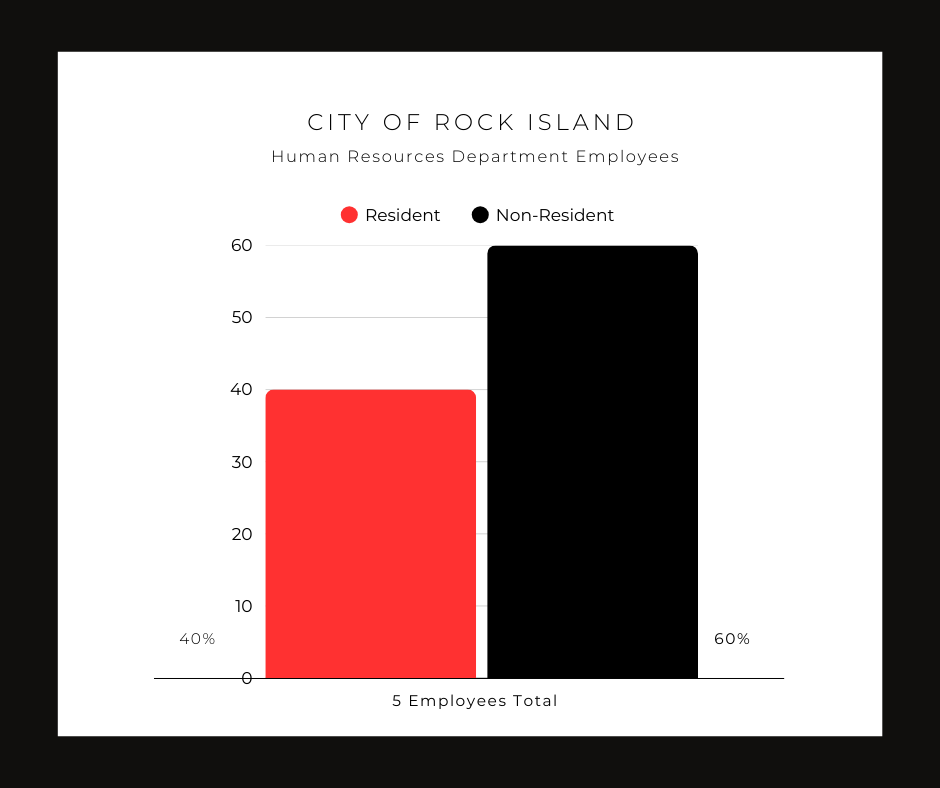
Feel free to peruse the following graphs which examine residency by department and overall.





REFERENCES:
Hirsch, B. T., & Rufolo, A. M. (1985). The economic effects of residence laws on municipal police. Journal of Labor Research, 6(1), 69–86. https://doi.org/10.1007/BF02685271
Learning Policy Institute. (2017). Teacher residencies: An innovative model for preparing teachers. https://learningpolicyinstitute.org
Murphy, K., & Worrall, J. L. (1999). Residency requirements and public perceptions of the police in large municipalities. Policing: An International Journal of Police Strategies & Management, 22(3), 327–342. https://doi.org/10.1108/13639519910285122
Sunshine, J., & Tyler, T. R. (2003). The role of procedural justice and legitimacy in shaping public support for policing. Law & Society Review, 37(3), 513–548. https://doi.org/10.1111/1540-5893.3703002
USA Today. (2020, June 13). Should police officers be required to live in the cities they patrol? There’s no evidence it matters. https://www.usatoday.com/story/news/nation/2020/06/13/police-residency-data/5327640002/
Villa, D. (2021). Measuring the impact of residency requirements and the relationship with the citizens in the community (Doctoral dissertation, DePaul University). Digital Commons @ DePaul. https://via.library.depaul.edu/soe_etd/215
Guha, R., Hyler, M. E., & Darling-Hammond, L. (2016). The teacher residency: An innovative model for preparing teachers. Learning Policy Institute. https://learningpolicyinstitute.org
Jackson, C. K., Rockoff, J. E., & Staiger, D. O. (2014). Teacher effects and teacher-related policies. Annual Review of Economics, 6, 801–825. https://doi.org/10.1146/annurev-economics-080213-040845
Papay, J. P., West, M. R., Fullerton, J. B., & Kane, T. J. (2012). Does an urban teacher residency increase student achievement? Early evidence from Boston. Educational Evaluation and Policy Analysis, 34(4), 413–434. https://doi.org/10.3102/0162373712454328
Solomon, J. (2009). The Boston teacher residency: District-based teacher education. Journal of Teacher Education, 60(5), 478–488. https://doi.org/10.1177/0022487109347671


Comments