


Rock Island's Many Parts: Using Internal Family Systems (IFS) for Community Work

Updated: Aug 18, 2025
The current formats available to community members to discuss collective issues often exacerbate division, fail to build community, and struggle to uncover consensus. Where do communities come together to "talk it out?" By making a statement at a city council meeting? By commenting in a disorganized social media thread? By meeting in small groups of like-minded people to craft arguments and position statements? While these are all valid types of communication, they do little to foster connection, creative problem-solving, and lasting community engagement.
As I watched Rock Islanders I respect and care for stake out opposing positions related to the moratorium proposed in response to the opening of The Third Place, I thought to myself, we must find a "third way" to discuss these important issues.
I believe grounding the dialogue in an Internal Family Systems (IFS) therapeutic model may deepen community connections while promoting solutions that address the hopes and concerns of all parts of the community.

1️⃣ Introduction to Internal Family Systems (IFS)
IFS is a therapeutic model built on the idea that each person has many “parts” — some protective, some vulnerable, and all important to the overall well-being of our system. The following graphic provides an overview of the major roles in the system: our protectors (managers & firefighters), our exiles, and our self-energy.
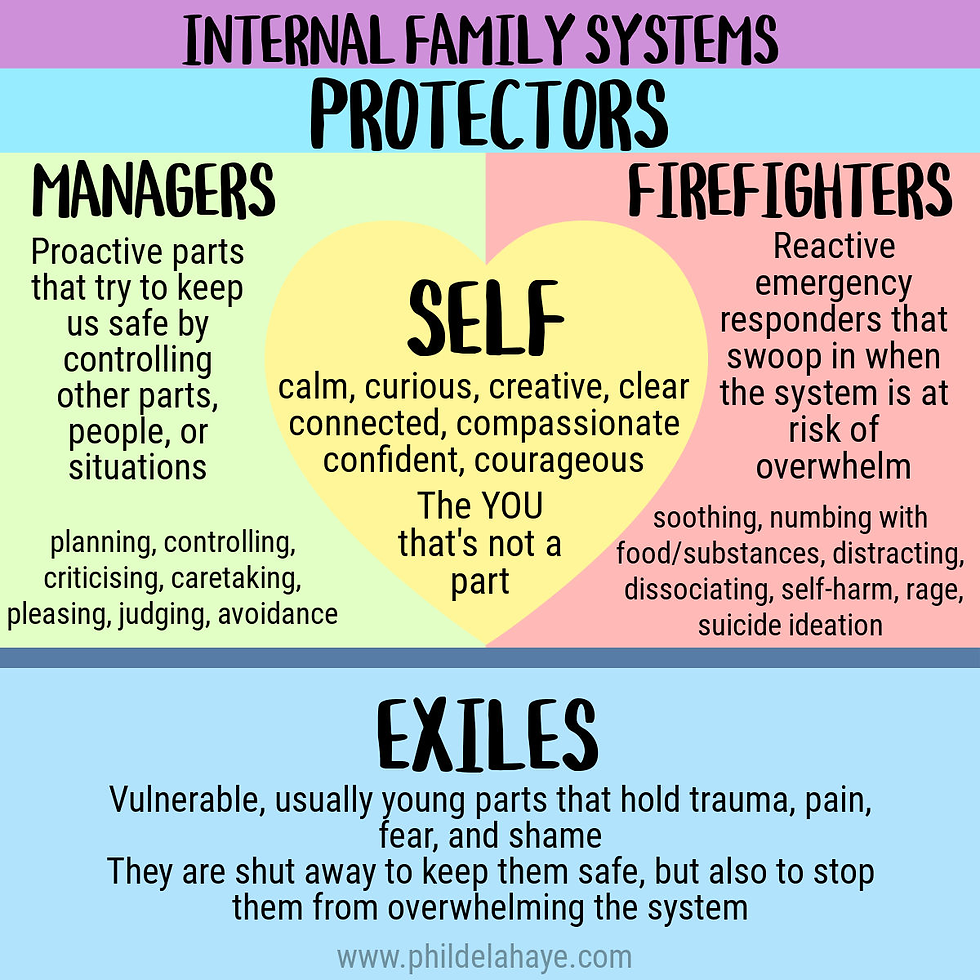
The goal in individual therapeutic work is to get to know the parts, befriend them with compassion and curiosity, value what they are trying to accomplish, and, when they are very extreme in their roles, to get them to relax so that more of one's self-energy can carry one through life.
Just as individuals have parts, communities do too — and every part has a role in shaping how we respond to challenges like literacy, intimate partner violence, homelessness, drug use, etc.
The purpose of this article is to explore how Rock Island can use IFS to deepen connections and strengthen solutions in our community.
2️⃣ The “Parts” of Rock Island
The purpose of identifying "parts" of a community is to more deeply understand our community, how we collectively function, and to increase the self-energy of our community. I prefer to call it the "Soul of the City."
As an aside, this name fits nicely with an upcoming event in Rock Island. Check out here: https://www.mlkcenter.org/events/soul-of-the-city.
City Soul is described as a state of being where we are collectively able to access more: connectedness, creativity, compassion, curiosity, calmness, confidence, courage, and clarity. No person or system can live in SOUL or self all the time, but the more access we have to these qualities, the more well-being we experience. When we are in states of high stress, feel the stakes are high, or have lost our collective sense of agency, our parts tend to become more extreme, noisier, and more adamant their needs are met as they fear the system, the person, or the city will not be able to care for itself without their extreme position.
Looking at Rock Island specifically, we can use curiosity and compassion to say "hello" rather than "uh-oh" to whatever parts arise. Rather than blaming or shaming parts, we try to understand their function and how they fit into the overall network. Some examples might include:
The Business Community
Role: Protecting economic stability, ensuring customer comfort, wanting downtown and neighborhoods to feel safe and welcoming.
Concerns: Impact on commerce, perceptions of safety, costs of solutions, feeling ill-equipped to handle social problems, feeling unsafe
Social Service Providers
Role: Meeting urgent needs, providing food, shelter, treatment, and case management, saving lives.
Concerns: Limited resources, high demand, burnout, long-term solutions, worried that others don't care about the vulnerable
Customers and Visitors
Role: Engaging with public spaces, supporting local economy.
Concerns: Comfort, safety, perception of downtown vibrancy.
Police and Public Safety
Role: Responding to calls, enforcing laws, and navigating situations often related to mental health or addiction.
Concerns: Public order, lack of appropriate tools/resources to address root causes.
Artists and Cultural Leaders
Role: Reflecting the truth of the community, creating space for empathy and new perspectives.
Concerns: Making sure stories are told, and community dialogue is inclusive.
Residents Without Stable Housing (“Exiles” in IFS terms)
Role: Holding lived experience, carrying the burdens of trauma, poverty, and systemic challenges.
Concerns: Survival, dignity, safety, pathways to stability.
3️⃣ The Systemic Dynamic
At times, two parts or several parts can come to a severe polarization in which they oppose one another with more and more energy and determination. Think of a small sailboat with one part leaning hard out of the boat to the left. To create balance, another part has to lean hard out of the boat to the right. The self in the middle gets lost in negotiating conflict and experiences a lack of balance and centeredness. In the individual model, an example of this would be the dynamic between restriction and binging in the treatment of disordered eating. The restricting parts have a set of objectives, the binging parts have a set of objectives. The extreme parts interact in opposition to one another and the self in the middle is lost. Parts work helps the individual to reclaim balance, settle the parts, and operate from a space of self-energy.
In a community setting, a polarization between parts might look like:
Speaking over each other instead of with each other.
Protecting themselves by avoiding vulnerability.
Acting from fear instead of curiosity.
Demonizing or devaluing one another
Recruiting other parts in the system to be on their side
Experiencing burnout, fatigue, and helplessness
4️⃣ The Goal: Building a “Soul-Led” Community
In IFS, healing happens when all parts are seen, heard, and understood. As parts get to know one another and trust that there are shared values, shared underlying principles, etc., the parts can relax, more easily communicate, and stay connected through conflict.
For Rock Island this might look like:
Creating forums where each “part” can speak without being dismissed.
Bringing compassion and curiosity to every perspective.
Holding a shared goal: a safe, thriving, welcoming Rock Island for everyone.
5️⃣ Moving Forward
Suggest small first steps:
Community conversations that invite multiple perspectives.
Art projects that tell the stories of each “part.”
Partnerships that build bridges between business, services, and residents.
Integrating an IFS approach to difficult community conversations as a community tool
6️⃣ How the IFS model might work for community issues
Internal Family Systems offers a model for community engagement that leads to deeper understanding, a relaxation of extreme postures, and solutions that have staying power as they foster community buy-in and engagement. Rock Island isn’t “broken” — it’s a system of parts doing their best to protect what matters most to them.
The invitation: What would it look like to move toward Soul-leadership as a community?
I would like to be a part of engaging with our neighbors in a different way. I hope to invite some folks to engage around the topic of homelessness through this model and see where we might get as a community.
In order to provide a sense of what this looks like in action, consider the following general facilitation of a "third way" to address community issues.
A meeting of community "parts" is called (business owners, law enforcement, customers, social service providers, unhoused folks, etc.)
Each "part" meets in a small group and is invited to embody the most extreme positions of this part (recognizing that each of us is made up of many parts as individuals) through a series of questions like:
What do you feel in or around your body when you are in this part?
What are you concerned about?
What is your role? What do you do to perform this role?
What do you most hope for?
What are you afraid would happen if you didn’t perform this role?
A neutral 3rd party (like a community actor) volunteers to embody the part and engage in dialogue with the other part(s) volunteer representative. The audience of participants is given instructions on how to witness with "self-energy."
The therapist(s) uses IFS techniques to invite participants to reflect on how they feel toward the parts before them through a series of questions and meditations until a core group of participants can sense a feeling of increased neutrality, compassion, connectedness, etc. toward both parts before them.
The parts return to their group and explore what they would "need to know" about the system - in this case, the community or city - in order to take a less extreme position as solutions are sought. This is done through a series of questions and meditations such as:
Is there anything you need the system to understand before moving forward?
What do you need in order to not work so hard?
What would give you more trust in the system's ability to care for itself?
The representatives return to the whole group and demonstrate understanding toward one another with the community of "self" or "soul" witnessing. New language is introduced for future conversations that identifies that we can feel different things at different times and in different situations. Community members can now say:
There's a part of me showing up that is worried about safety.
There's a part of me showing up that is concerned I won't be supported.
There's a part of me that feels overwhelmed when I don't know how to handle a situation going on at my business.
There's a part of me that wants to take care of people that is scared someone will get hurt if I don't act
There's a part of me showing up that will do anything to survive, including breaking the law to access food, shelter, or water
There's a part of me that feels conflict because I care about other humans and I have a personal boundary I need to honor
When individuals, couples, families, and communities communicate in this way - it improves communication dramatically. In IFS, we call this the U-TURN. When we feel intensely, we try to look inward and identify which "part" is activated, name it, and recognize that it's not the entirety of who we are, but it is at the forefront in the moment.
IFS facilitators do not have an agenda. In this way, there is not necessarily an outcome or objective to be "achieved," but the hope is that when "parts" encounter one another at a planning meeting or in conversation moving forward, they will have more soul-energy to bring to the communication.
I understand this is probably confusing and might not make sense until it is tried in real time, but I am hoping some members of the community will be willing to try a "third way" with me.


Comments